
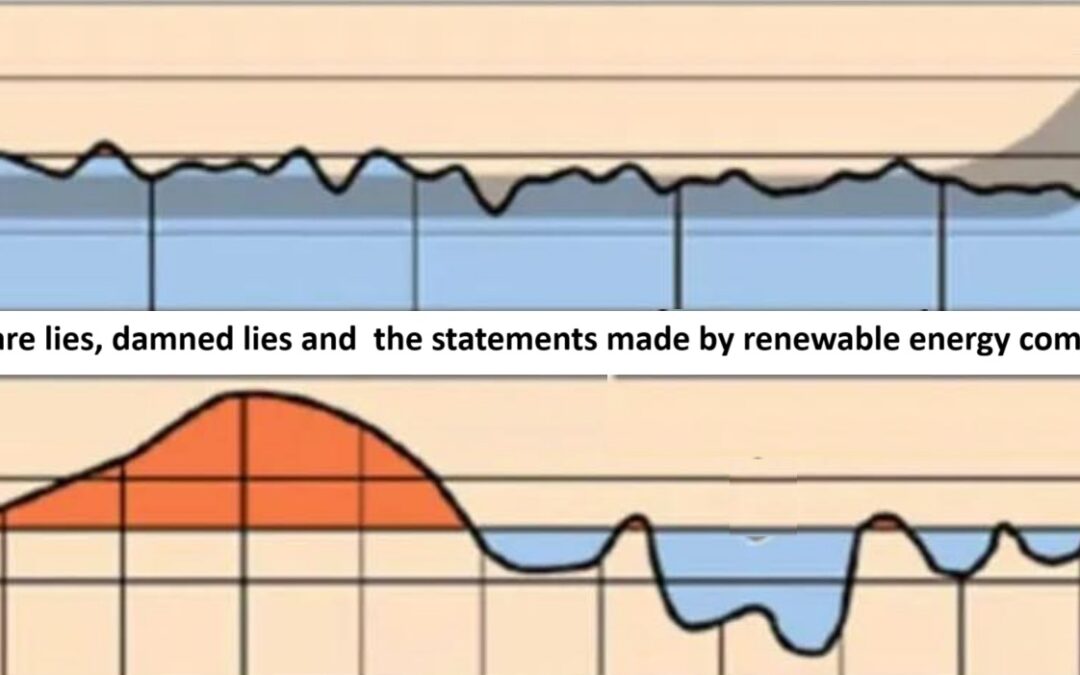
In this post, we examine some of the misleading solar farm claims made by Rheinisch-Westfälisches Elektrizitätswerk (RWE) in its planning application for the Monskfield Solar Farm. Of course, they could all be the result of incompetence (some clearly are!), but to us many appear to be deliberate attempts to either exaggerate the benefits or disguise the harms that this development would bring if allowed to proceed. It is certainly strange that none of them seem to disadvantage RWE!
The material shown below is quite serious stuff. However, if you want some lighter entertainment, we created a spoof version of RWE’s construction plan for the cable laying to the MHDC planning portal which you can view here. Its purpose is to provide a layperson’s translation of what RWE actually submitted.
 Exaggerating the benefits
We’ve already exposed RWE for exaggerating the benefits of Monksfield Solar Farm in our “The solar benefits con” article. In summary:
- The CO2 savings are the equivalent of 25,000 cars off the road for the lifetime of the solar farm, not 1 million as claimed (unless you assume it was ok to put the 25,000 in year 1 back on the road for year 2 so that you could claim another 25,000 in year 2!!
- The solar farm would meet the domestic energy needs of 5,500 homes not the 19,894 claimed on its Chapel Hill Solar Farm website nor the 24,660 claimed in the planning application itself (these were the electricity needs, not the energy needs which is not what they said)
We also pointed out, that whilst this solar farm could have been different, there is a good chance that the electricity generated would not have gone towards powering local homes. In other solar farms, RWE made similar claims but then contracted to provide the electricity to commercial clients. You can verify this by going reading RWE’s press release, and then read their planning statement (page 22) for Cotmoor solar farm.
 Incompetence
Some of the errors are clearly incompetence. It does make you worry though – supposing their electrical engineers were similarly incompetent when it comes to maths? The battery energy storage systems (BESS) are a known fire risk anyway, but I’d be worried about the whole thing going bang when it was connected to the grid due to some voltage calculation error!
Take this statement in their overplanting statement submitted as part of the planning application:
“80.06 x 24 x 365 x 18.28% x 0.532= 48,618.67 tonnes of CO2 will be avoided per year of operation of the solar farm”
Well actually, when I multiply those numbers together I get 68,203. Upon querying this with RWE’s development manager, the 80.06 should have read 49.9. This of course then gives the answer 42,510 when multiplying the figures together – which tallies with the number that I’d managed to work out for myself. So there were actually two errors here: the 80.06 was wrong and so was the 48,617. This suggests that
- the author of the document didn’t really understand it themselves
- quality control on their documents is poor
Perhaps the best example of incompetence though is one that also illustrates RWE’s idea of community engagement: In their planning application document, RWE reference “Worchester” rather than “Worcester” as the location of the solar farm!! Problem with having a German parent company, Dutch development manager (reminds me of Steve McClaren when he managed FC Twente adopting a Dutch accent!) and a bunch of young “project managers” who probably hadn’t heard of the Malvern Hills let alone Worchestershire?
 Misleading statements
BESS access points
A key requirement of the National Fire Chiefs’ Council guidelines on BESS fire safety is that each BESS compound should have two access points. This means that firefighters can access the BESS without the wind blowing toxic fumes in their direction – so for good safety reasons.
In their “Outline Battery Safety Management Plan”, RWE states that “The site is spread across a number of fields all with three primary points of access to the BESS compounds within the solar farms”. So if there were 5 fields, you would think 15 access points, right? WRONG! There are in fact 3 access points covering the site as a whole! The reality is each BESS compound, of which there are 13, has one access point.
I think that this is what some might call “wordsmithing”. I would call this a “renewable energy company statement” – as per the words in the diagram at the top of this post.
Dodgy table
In their Landscape Visual Impact Assessment, RWE provides a table to show that the impact on the local landscape character in terms of magnitude / effect is low / minor (year 1) and negiligle / negligible (year 15) at the top of the table.
However, this refers to the Leigh Sinton area as a whole, with the individual land parcels in which the development sits lower down in the table revealing the true medium / moderate and low / minor effects.
It would be like me saying that the wind turbine in my garden has negligble effect in the UK as a whole and in Worcestershire, but moderate / low effect on my neighbours. Clever as of course it is not a lie, but takes some digging into the detail to get to the real picture. Given that RWE’s HQ is in Essen, Germany, perhaps they could have inserted another row at the top of the table referring to Europe? One for their propaganda marketing department to pick up on as a “could do better next time”.
Independent survey
Stating in a public meeting that their survey was independent when in fact it was far from it. The forms that residents were asked to complete did not have the option to state that the respondent disapproved of the proposed development. Further, where respondents plucked up the courage to replace “I support” with “I do not support”, many such forms were simply not uploaded to the MHDC planning portal. We also heard of residents who, as soon as they revealed that they were against the site, received a quick good bye and were not invited to complete a form.
Examination of the job descriptions for recruits of their publicity company Your Shout shows that their role is to “show them how our proposed buildings will benefit the local area and ask them to show their support” rather than to “conduct independent surveys”.
Analysis of submissions uploaded to the MHDC planning portal showed a dearth of respondents in the area affected by the development but many responses from areas further afield.
Disguising Highways safety and disruption issues
In their Construction Traffic Management Plan, RWE claim that only 5 accidents occurred within 250m of the site entrances in a 5 year period. However, the appendix of the same document details 10 such incidents. Furthermore, RWE states that there is no pattern to these accidents. However, 60% involve queuing traffic and vehicles turning off the main road, both of which, in our opinion, are circumstances that would be likely to increase given the proposed roadworks that would be required and the construction traffic entering / leaving the construction site.
In its construction method statement for cable laying, RWE headlines a 7-month period for laying the cable along the A449 and Springfield Lane to connect the site to the National Grid. Buried in the detail of the report is a statement that this is dependent upon having two teams working on the cable-laying for the duration, but that their expectation is that there will only be one team. We conclude that in reality, cable-laying will take 14 months. Clever, as it enables them to claim 7 months but if anyone complains they can state that they had mentioned the possibility of 14 months in the body of their document!
In this document, RWE also state that the speed limit on the A449 is 40mph in the vicinity of the solar farm. In fact, this is not true as it is subject to the national speed limit for a single carriageway road of 60mph (96 km/h if you are a German RWE employee reading this!) reducing to 50mph (80 km/h) just to the East. I’m sure this is just either laziness or budget saving as the potential millions of euros of profit that this scheme would lead to would not merit an RWE representative actually travelling along the A449 to have a look and check their facts!
RWE claim that the cable route only progresses 80m along Spring Lane. However, the sub-station is a lot further along than that as a cursory glance on google maps reveals. This might be to disguise the disruption to local businesses etc whilst the road is being dug up – a road that normally has vehicles parked along it during the day.
As an aside, the sub-contractor who put this document together for RWE couldn’t even get the name of the UK subsidiary right, nor actually manage to include all the diagrams that were meant to be contained in the appendices, as our spoof version of their report uploaded to the planning portal flags!
Hopefully you get the picture. There are simply too many shoddy, misleading and arguably deceitful things to mention them all.